Adult scoliosis: your guide from first visit to treatment
Short answer. Adult scoliosis is a sideways curve of the spine, often with a loss of the spine’s normal front-to-back shape. Many adults with a curve need no surgery. Treatment depends less on the size of the curve than on how much it affects your pain, walking, standing and daily life.
What kinds of scoliosis do adults have?
- Scoliosis from your teenage years that has carried into adulthood. Some of these curves grow slowly over decades.
- Degenerative (“de novo”) scoliosis. The curve starts in adulthood as discs and joints wear unevenly, usually after 50.
- Flatback after earlier surgery. Some people lose the lower back’s natural inward curve after a prior fusion.
Read more: Scoliosis after 50 · Flatback syndrome
What symptoms do adults have?
Adults usually come in because of how they feel, not how the curve looks.
- back pain, often worse after standing or walking
- leg pain, numbness or heaviness from pinched nerves
- tiring quickly or leaning forward as the day goes on
- trouble with shopping, cooking or yard work
Some adults have a curve on X-ray and no symptoms at all, and need only occasional checkups.
What happens at a first visit?
- 01
Your story
What bothers you most, what you can no longer do, what you’ve tried, and what you hope to get back.
- 02
Watching you stand and walk
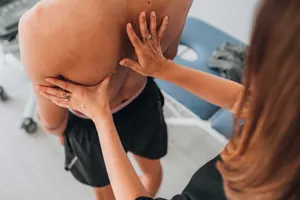
Whether your head is level over your hips, whether you lean, and whether your hips or knees bend to keep you upright.
- 03
Full-length standing X-rays
Front and side, including the hips. The spine looks different when you lie down. EOS low-dose standing imaging is available at our Kettle Point office.
Read more: What scoliosis X-rays show
How do your X-rays relate to what bothers you?
The front view shows the sideways curve, measured as the Cobb angle. The side view often matters more for symptoms: it shows whether the spine has lost its curves and how hard your body is working to hold you upright.
When the lower back flattens, the body tilts the pelvis back, flattens the upper back and finally bends the knees. My research shows people use these strategies in a predictable order, and that whole-body alignment tracks closely with disability. That is why two people with the same curve can feel very differently. Why is it getting harder to stand up straight? →
 My article · Brown University Health, July 2024Adult scoliosis: treatment and success storiesHow adult scoliosis develops, what non-surgical care can do (physical therapy including aquatic therapy, pain management, bracing in select cases, lifestyle changes), when surgery is considered, and three patients’ outcomes.Read on brownhealth.org →
What are your options?
Watching it
If you’re comfortable and stable, regular checkups with X-rays may be all you need. I usually recheck at 4 months, at 6 months if needed, then at 1, 2, 5 and 10 years.
Nonsurgical care
The usual first step. The evidence is limited, but it helps many people manage pain and stay active.
- physical therapy, core strengthening and aerobic exercise such as walking, cycling or water therapy
- anti-inflammatory and some nerve-pain medicines
- injections for nerve or joint pain
Bracing, which helps teenagers, does not stop curves growing in adults.
Reconstruction surgery
Surgery straightens and stabilises the spine with screws and rods, and often relieves pinched nerves. In a large North American study, people who chose surgery were more than twice as likely to have a meaningful improvement in pain and function: about 86% versus 39% at two years, with gains lasting to eight years.
It is a major operation. About 14% of surgical patients in that study had at least one additional operation. Major complications and repeat surgeries have fallen by about half over the past decade.
Read more: Is surgery worth it? · Treatment without surgery · Recovery after surgery
How do we decide?
- how much the condition limits your daily life
- whether your nerves are affected
- whether the curve or forward lean is getting worse
- bone strength
- smoking, other health conditions and your goals
Read more: Osteoporosis and spine surgery · Spondylolisthesis surgery
What to bring to your first visit
Bring
- Prior spine X-rays, MRIs or CT scans: the actual images, not just reports
- Notes from physical therapy, injections or other doctors
- A list of your medicines, including any for bone health
- Your most recent bone density scan (DEXA), if you have one
- Two or three questions you most want answered
Had spine surgery before? Use the revision checklist instead →
When should you be seen sooner?
Contact a doctor promptly for new or worsening leg weakness, trouble controlling your bladder or bowels, numbness in the groin, or rapidly worsening pain or posture.
Sources
- Diebo BG, et al. Adult Spinal Deformity. Lancet, 2019. PMID 31305254.
- Diebo BG, et al. Recruitment of compensatory mechanisms in sagittal spinal malalignment. Spine, 2015. PMID 25705962.
- Diebo BG, et al. Global Sagittal Axis. J Neurosurg Spine, 2016. PMID 27203811.
- Kelly MP, et al. Operative versus nonoperative treatment for adult symptomatic lumbar scoliosis. JBJS Am, 2019. PMID 30801373.
- Smith JS, et al. Operative vs nonoperative treatment for adult symptomatic lumbar scoliosis at 8-year follow-up. JAMA Surgery, 2025.
- Pellisé F, et al. Quality metrics in adult spinal deformity surgery over the last decade. J Neurosurg Spine, 2022. PMID 34598152.
More background: Scoliosis Research Society patient information srs.org.